
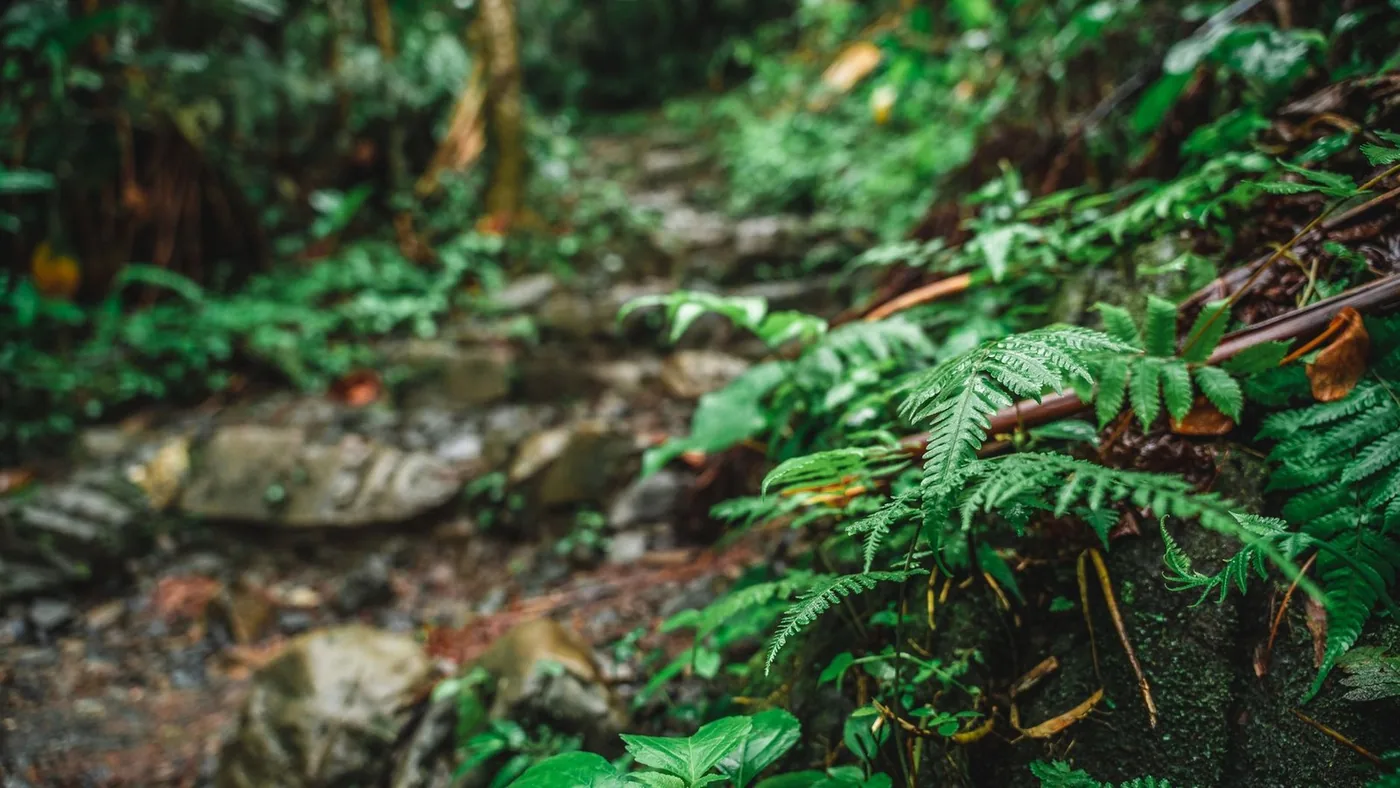
Almost everybody arrives in a tropical rainforest with the wrong expectations, most of them supplied by television. The documentary version is a continuous parade of charismatic animals at eye level in good light. The real thing is a hot, dim, extraordinarily complex place where most of the life is somewhere above your head, most of it is either still or extremely fast, and the first morning can feel oddly empty.
The heat and humidity are the first adjustment. Under a closed canopy the air barely moves, the humidity sits near saturation, and a walk that would be trivial at home becomes genuinely tiring. Everything stays damp: clothes, boots, camera, paper. Experienced guides move slowly and stop often, which turns out to be the right technique for spotting things as well as for staying upright.
The second adjustment is learning to look up, and to listen more than you look. The canopy is where the productive life is — the fruiting trees, the primates, the hornbills, the great majority of the birds — and from the forest floor you will hear ten times more than you see. Guides find animals by sound and by movement, and after a day or two you begin to notice that you are doing it too.
The third is scale. A single hectare of Bornean lowland forest can hold more tree species than the whole of Britain, and the structure runs in layers, each with its own inhabitants: emergents above the canopy, the canopy itself, the sub-canopy, the understorey, the floor. Once you can see the layers, the apparent chaos resolves into something organised, and the forest becomes much easier to read.
What you actually encounter is mostly small and mostly astonishing. Columns of ants running a highway across the path, a stick insect the length of a forearm, fungi glowing faintly at dusk, a leech looping toward your boot with real determination, the sudden crash of something large going away from you through the branches. The big sightings, when they come, are wonderful precisely because they are not guaranteed.
Practicalities matter more here than in most landscapes. Long sleeves, leech socks, boots you do not mind soaking, a dry bag for anything electronic, more water than you think, and a torch for the dusk walk back. Go with a licensed local guide, both because you will see perhaps five times as much and because the forest is genuinely easy to get lost in once you are twenty metres off a path.
The conservation picture behind the visit is impossible to ignore, and should not be. The lowland forests of Borneo and Sumatra have been reduced dramatically within living memory, largely for timber and plantation agriculture, and the remaining blocks are fragmented. Organisations such as WWF track the numbers, and the short version is that where forest tourism pays a community more than clearing does, forest tends to survive.
That is the argument for going, done properly. Use local guides and locally owned lodges, keep groups small, accept that wildlife is not on a schedule, and spend at least two days so that you have time to stop expecting a documentary and start noticing the place. The forest does not perform. It simply gets slowly more extraordinary the longer you are prepared to stand still in it.